
The Micromart Smart Store: How It Works, What It Costs, and Where It Fits
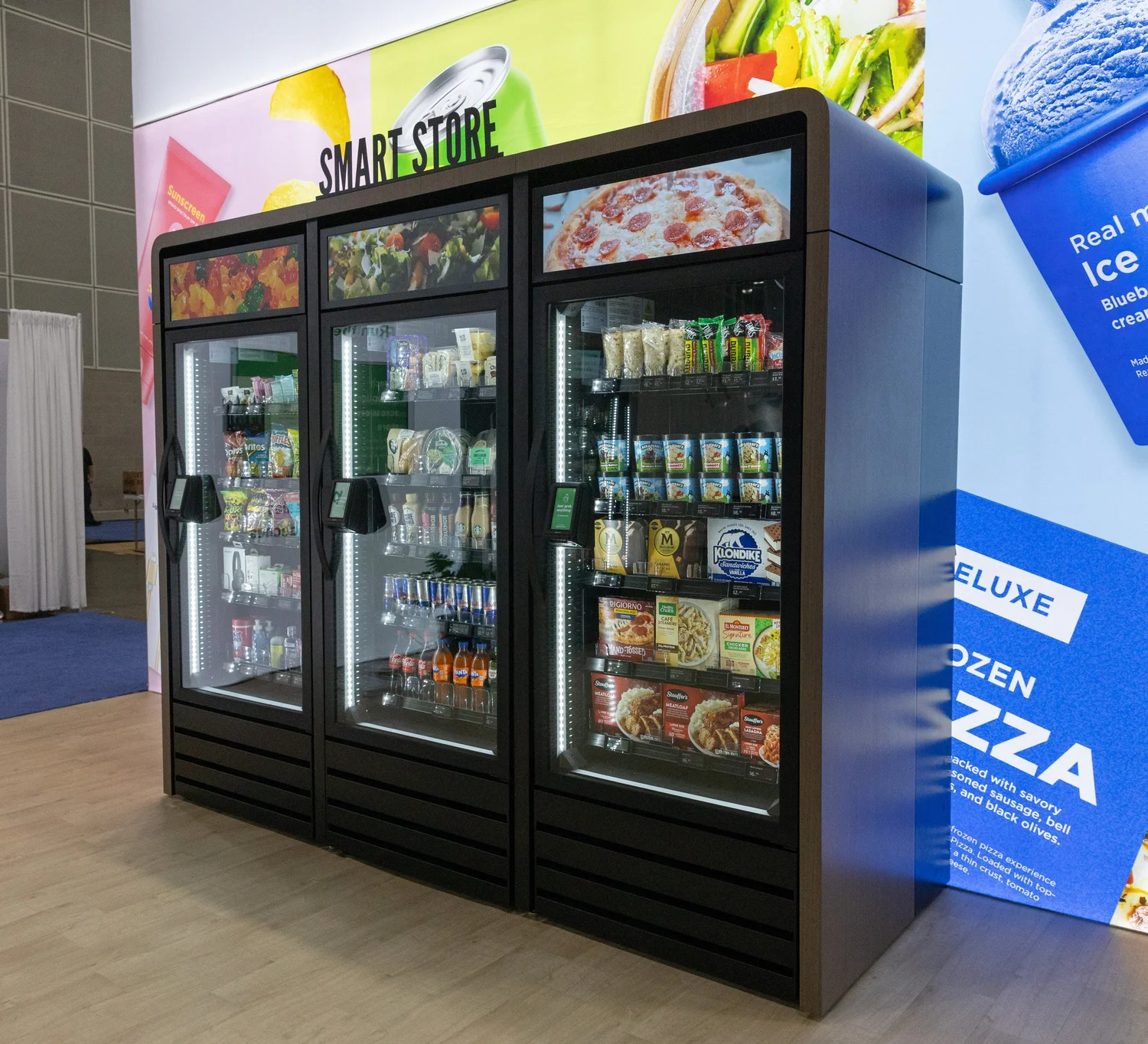
Three cabinets, one store. Customers tap a card, take what they want, and close the door.
A Micromart Smart Store is a locked, glass-door cabinet that unlocks when a customer taps a payment card. AI cameras inside see what gets taken, the door closes, and the card is charged once for everything in their hands. You can stand two, three, or six cabinets side by side, mix cold and ambient, and wrap the whole run in one wood surround so it reads as a small store instead of a row of machines.
What Is a Micromart Smart Store?
It is a single-door commercial cabinet — about 79" tall, 30.5" wide, 36.7" deep and 350 lbs — with no keypad, no coils and no delivery bin. The customer opens the door and picks the product up with their hand, exactly like a convenience store cooler.
What makes it a store instead of a fridge is the layer on top: a smart lock that stays shut until a card is pre-authorized, inward-facing AI cameras that identify every item removed, ePaper price tags on the shelf edges, an HD display across it, and a cellular connection so the operator can watch and change everything remotely. Micromart launched the line in June 2024, builds the cabinets in Canada, and says it has around 2,000 Smart Stores deployed across the US and Canada.
How Does a Customer Actually Buy Something?
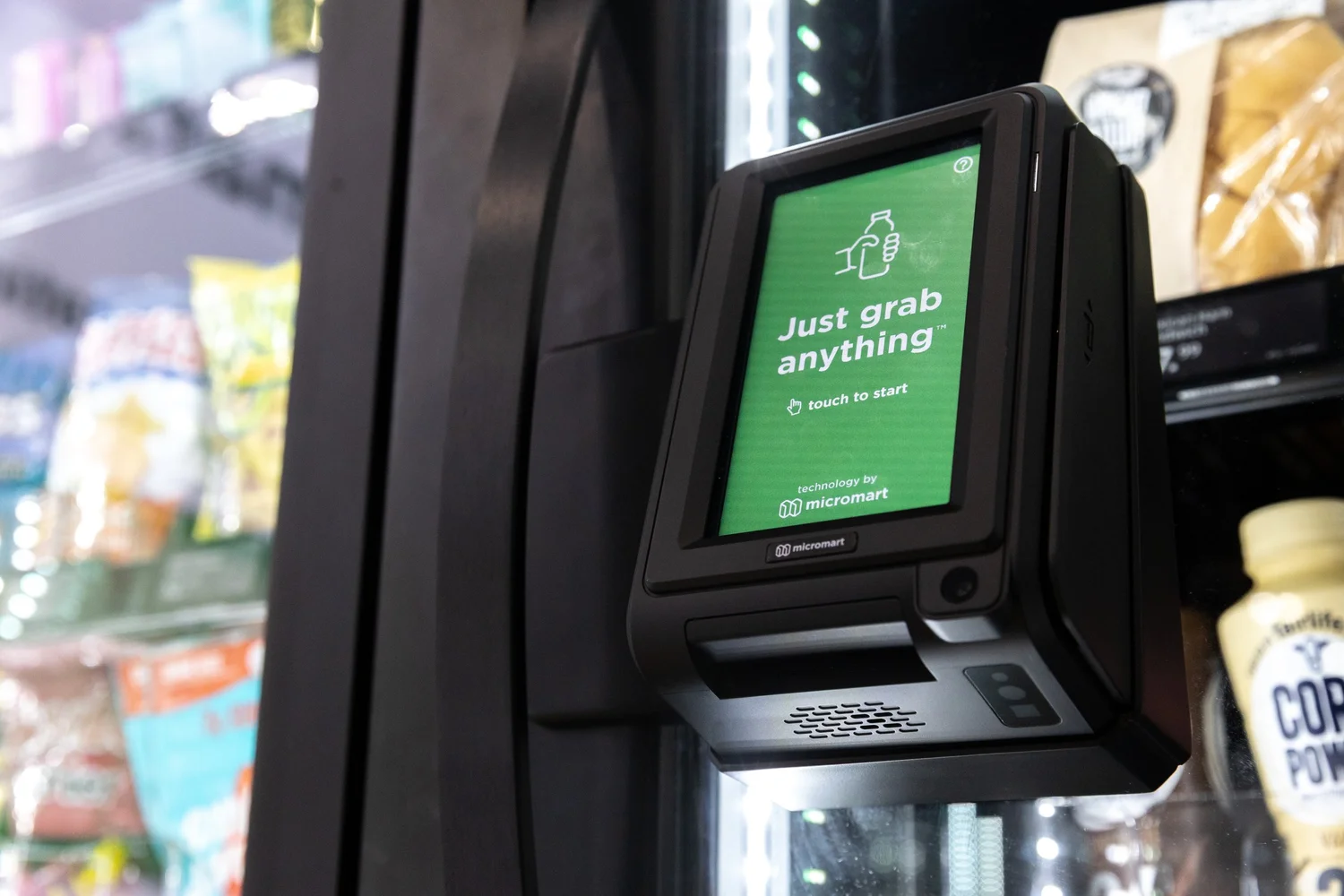
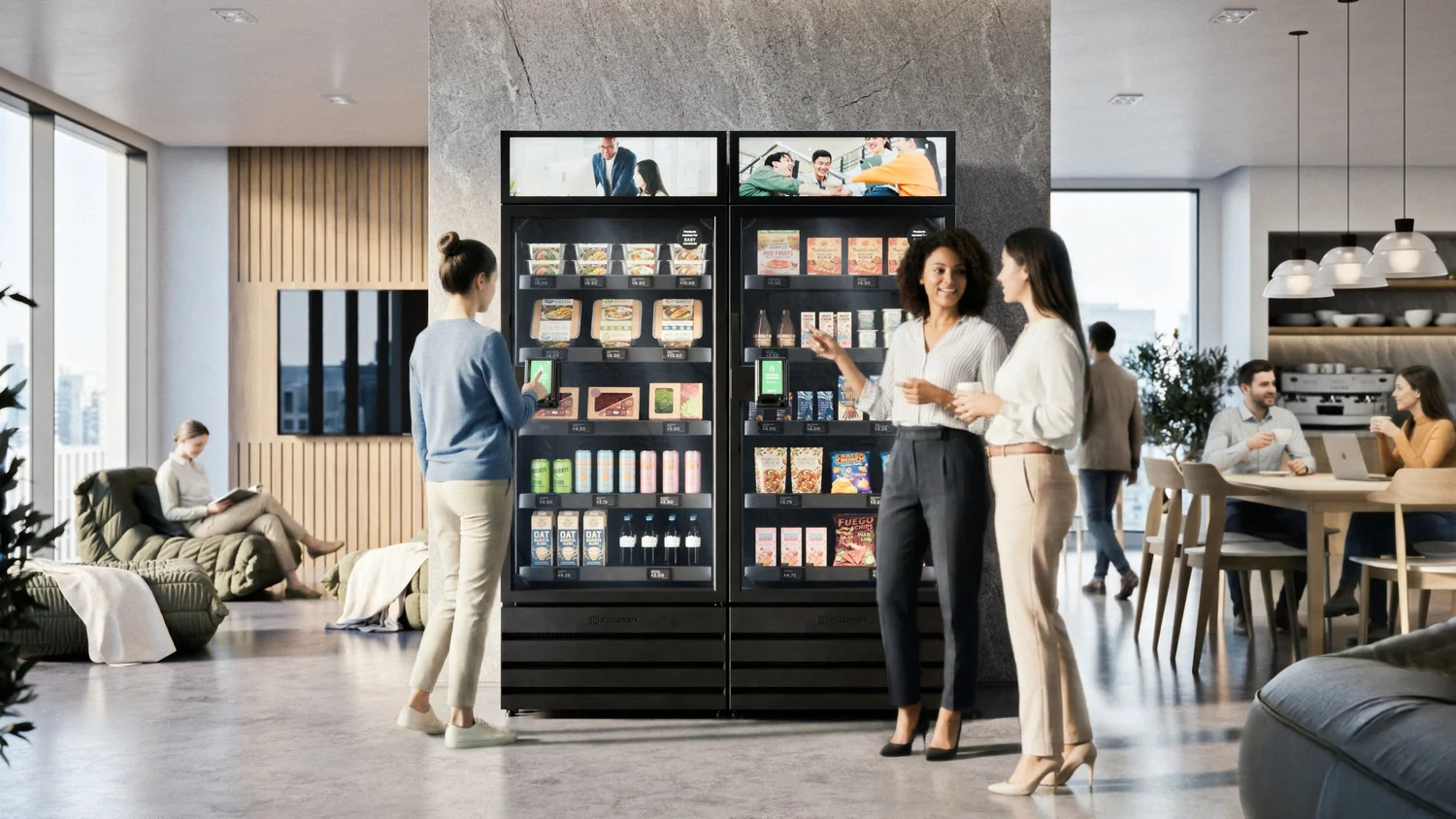
Five steps, and none of them involve a cashier. The customer taps or inserts a card, the terminal runs a pre-authorization, the lock releases, they take whatever they want, and closing the door ends the transaction. Everything taken across the whole store is billed as one charge on one receipt, sent by SMS within a few hours. Put something back before the door shuts and it drops off the bill.
The cameras identify products by packaging shape, colour, size and position — no weight sensors, no RFID, no barcode scanning. Micromart rates recognition accuracy at 99.5%. Two things fall out of that design, and they should shape your planogram before you order:
- Nothing much under 4 inches. If an item vanishes inside a closed hand the cameras can't see it leave. Micromart names 5-Hour Energy shots and Tic Tac boxes as products it cannot stock.
- Look-alike packaging needs separating. Two nearly identical SKUs belong on opposite sides of a shelf, not next to each other.
It takes Visa, Mastercard, Amex, Discover, Apple Pay and Google Pay. It does not take cash, and the terminal is English only — both worth knowing before you promise a location.
What Are the Three Units, and Can You Put Them Together?
There is no combo machine and no double-door model. Micromart's answer to "I need snacks and drinks and frozen meals" is to stand cabinets next to each other and run them as one store.
| Smart Pantry | Smart Fridge | Smart Freezer | |
|---|---|---|---|
| Temperature | 66°F | 35°F | −20°F |
| Sells | Shelf-stable snacks, dry goods | Drinks, fresh food, dairy | Frozen meals, pizza, ice cream |
| Price | $6,295 | $6,295 | $7,295 |
| 3 or more | $5,995 each | $5,995 each | Ask — not published |
| Lease to own | $230/mo × 36 | $230/mo × 36 | $245/mo × 36 |
| Cameras | 4 | 4 | 3 |
| Price tags | 30 ePaper | 30 ePaper | 25 ePaper |
Temperatures are set at the factory and cannot be changed in the field, so pick the mix before you order. One thing to ask about: Micromart's current hardware generation is Gen5, and its Gen5 spec sheet lists the Fridge and Pantry only — the Freezer is still marked "coming soon." The two generations differ in depth, amperage and cabling, so confirm which one is shipping.
Current cabinets need no side clearance, so they sit flush and read as one storefront — Micromart's own example is two Fridges plus a Pantry in about 90" of wall by 38" deep. Where you do still need room is behind and above: 1" at the back for airflow and 6" on top.
Can You Make It Look Like Part of the Building?
This is the part that wins the nicer locations, and there are three layers that stack.
The premium wood enclosure is supplied through Fixturelite, a micro-market fixture maker. It is modular and sized to however many cabinets you have — one, three, six — in a range of finishes and materials, and it can be added to an existing installation, not just a new one. Micromart doesn't publish a price for it, so it gets quoted per job.
On top of that, magnetic vinyl wraps stick to the cabinet sides and swap out easily, so a building can be branded for a tenant, a season or a sponsor without committing to anything permanent. And every cabinet has a 1920 × 540 HD display that takes video pushed remotely, with templates that let one video run across up to four cabinets instead of repeating on each. The ePaper price tags update remotely in seconds and show the tax-inclusive price by default — so the number on the shelf is the number that hits the card.
What Does One Cost to Put In?
Hardware is only part of it. A Fridge or Pantry is $6,295, dropping to $5,995 each at three or more; the Freezer is listed at $7,295 on Micromart's pricing page, though its own FAQ still shows $6,995 — worth pinning down before you quote anyone. Lease-to-own runs $230 a month for 36 months on a Fridge or Pantry, then a $300 buyout.
On top of the cabinet: $60 a month per unit for the software platform, card processing at 4% plus 10¢, a 5¢ per-transaction data fee, product pushers at $70 a shelf, a $20 SIM, a $60 implementation fee, and freight that usually lands between $400 and $800. Lead time is two weeks on a cash order, three on a lease.
For revenue, Micromart publishes one number: an average of $14,400 a year per machine. That is a company average across every location type — use it to start the arithmetic, not to finish it.
Two things to check before signing. Warranty is five years on the compressor, but coverage on the rest of the parts is published as three years on some Micromart pages and one year on others — get the term you're being sold in writing. And the cabinets are indoor only, rated to a maximum room temperature of 86°F, on a dedicated outlet, with either 10 Mbps of persistent internet or the built-in cellular SIM. Outdoor placement voids the warranty.
Where Does a Smart Store Beat a Vending Machine or a Micro Market?
The real difference between these three formats isn't features — it's where the barrier between the shopper and the product sits, and that drives basket size, shrink and what kind of room you're allowed to put it in.
A vending machine never opens the barrier: you pick a code and one item drops. A micro market has no barrier at all, which gives you the biggest basket but needs a dedicated, supervised room. A smart store keeps the barrier locked until a card clears and then opens completely — which is why it can go in a lobby, on a gym floor or in a hotel corridor where an open market can't. Micromart puts the average basket at 1.9 items, and that's the whole argument: a vending machine sells one thing, an open door sells a drink and a bar.
The industry has moved the same way. In Automatic Merchandiser's 2026 State of the Industry report, more than half of respondents now operate smart coolers, and smart coolers made up 33.5% of the equipment they had deployed — nearly matching traditional glass-front vending machines. Micro market growth has flattened over the same period, with 52.4% of respondents reporting no change in their micro market count in 2025, against just 16% back in 2023.
None of which retires the vending machine. Traditional equipment still wins on price per location and on sites where nobody is accountable for the space. The smart store wins the gap in between.
We sell, deliver, install, and service vending equipment across New York, New Jersey, and Connecticut. Tell us about the location and we'll tell you straight whether it suits a smart store, a traditional machine, or nothing yet.
Call (718) 744-6018Frequently Asked Questions
What does it cost the building to have one?
Nothing, in the standard operator model. The operator buys the cabinet, stocks it, services it and keeps the sales. The location provides about 30" of wall and an outlet.
Can someone just open the door and empty it?
The door won't open without a pre-authorized payment card, so anyone taking product has already identified themselves. The cameras track what leaves, and individual cards can be blocked. It isn't theft-proof — nothing with an opening door is — but the exposure is bounded and traceable in a way an open micro market isn't.
How many products does one hold?
Between 280 and 750 items depending on what you merchandise. Filled with nothing but 12-oz cans, a Fridge or Pantry holds about 378.
Does it take cash?
No. Card, Apple Pay or Google Pay only. In a cash-heavy location that's a dealbreaker rather than a detail, and it's the first thing to check before you place one.
Does Monclus sell and service smart stores?
Yes. We handle sales, delivery, installation and ongoing service across New York, New Jersey and Connecticut, and we ship machines to all 48 states. Call (718) 744-6018 or visit our warehouse in Hollis, Queens to talk it through.